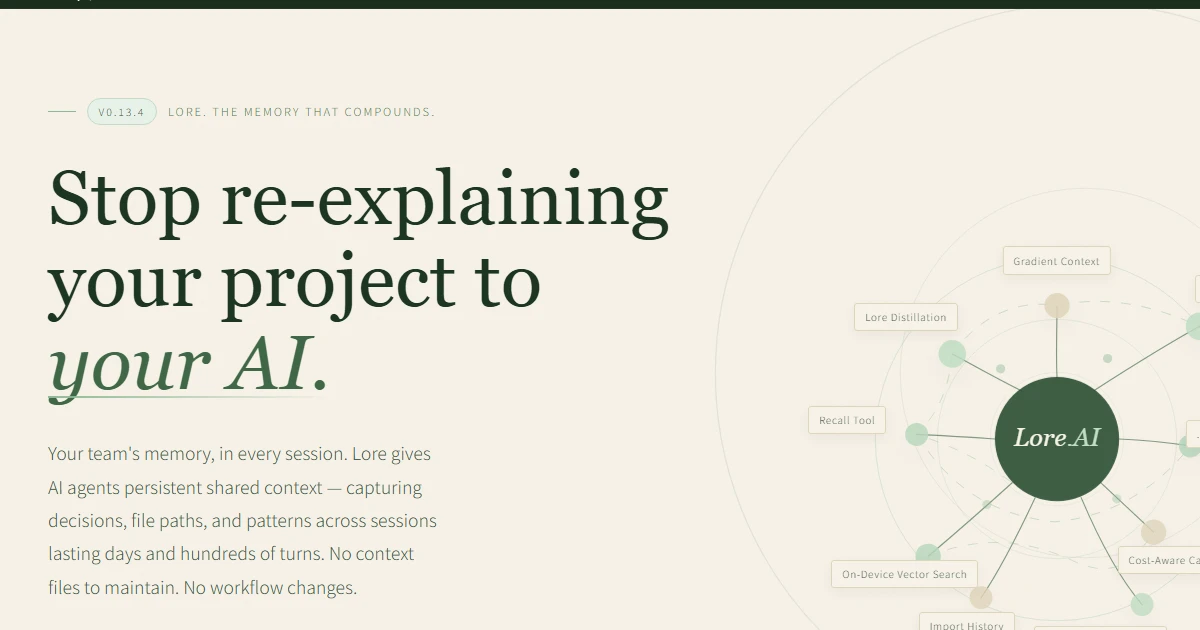
Lore
Local memory and context-management gateway that gives Claude Code, Codex, OpenCode, Pi, and similar coding agents durable shared recall.
Do not bounce yet
Read the fit check, compare one alternative, then decide whether the vendor page is still your best next click.
Quick Verdict
Fast fit check before you leave the page
Make the fit call first. Vendor pages are good at selling, but they rarely tell you where the product is a bad match.
- Developers already using Claude Code, Codex, OpenCode, Pi, or similar tools who keep hitting context and memory problems
- Teams that want project knowledge to compound across sessions instead of rewriting context files by hand forever
- Infra-minded builders who prefer local-first memory and search over uploading every transcript to another SaaS layer
- Still explicitly experimental, so APIs, storage format, and workflow behavior may change quickly
- FSL-1.1-Apache-2.0 is source-available rather than standard open source, which will matter for some teams
- The strongest benchmark and cost claims come from the project itself and should be validated on real workloads
Compare Next
Take one more internal step before the vendor pitch
This is where visitors usually jump out too early. Read one deeper take or open one alternative so the next click is informed instead of impulsive.
Alternative profile
context-mode
Source-available MCP plugin that keeps heavy tool output out of Claude Code, Codex, Cursor, and other coding-agent context windows.
Alternative profile
Mem0
Universal memory layer for AI agents that adds persistent context, retrieval, and personalization to coding workflows.
Alternative profile
OpenCode
Open-source coding agent for the terminal with provider-agnostic model support, built-in agents, and optional desktop/IDE surfaces.
Lore is a local memory and context-management gateway for coding agents. Instead of pretending a different chat window fixes agent reliability, it focuses on a real problem: your coding tools forget decisions, file paths, and prior fixes once sessions get long and compaction starts eating detail. Lore tries to preserve that operational memory across tools like Claude Code, Codex, OpenCode, and Pi.
Lore is one of the more defensible new memory-layer additions because it is trying to solve a real failure mode in agentic coding instead of shipping another disposable wrapper. It runs as a local gateway that auto-detects tools like Claude Code, Codex, OpenCode, and Pi, then combines session distillation, searchable recall, and curated long-term project knowledge so the agent can keep working across long sessions without depending on lossy compaction alone. The product is still early and experimental, but it is differentiated, source-available, publicly documented, and directly relevant to teams whose coding agents keep forgetting decisions, file paths, and prior fixes.
Why Choose Lore?
Lore attacks the actual continuity problem in agentic coding instead of offering another shallow agent wrapper or launch-week shell.
Because it works as a gateway and exports project knowledge files, it has a better portability story than memory features locked inside one editor product.
Its combination of raw session storage, distillation, recall, and curated long-term knowledge is materially more credible than vague "memory" marketing copy.
The project is early, but the public docs, repo, and launch signal are strong enough to justify paying attention now rather than after the ecosystem copies the idea badly.
Key Features
Local gateway that auto-detects Claude Code, Codex, OpenCode, and Pi, while also supporting other Anthropic- or OpenAI-compatible clients via base URL routing
Three-tier memory architecture spanning raw session storage, incremental distillation, and curated long-term project knowledge instead of relying on compaction summaries alone
Searchable `recall` workflow over stored messages, distillations, knowledge entries, and optional lat.md content using SQLite FTS5 plus local embeddings
Imports historical conversations from Claude Code, Codex, Aider, Cline, Continue, OpenCode, and Pi so the memory layer can start from existing work
Exports and syncs knowledge into AGENTS.md, .lore.md, or related project memory files so context stays portable across sessions and tools
Built-in local web dashboard for browsing projects, sessions, distillations, and knowledge without shipping everything into another hosted SaaS
Pros & Cons
- Targets a real long-session agent problem: losing decisions, file paths, and operational detail after repeated compaction
- More portable than editor-locked memory because the gateway and exported knowledge can move across multiple coding-agent clients
- Local-first storage, recall, and dashboard are a stronger trust story than opaque memory claims from hosted wrappers
- Public docs, repo, HN launch, and X launch signal make it a more credible addition than most same-week agent tooling noise
- Still explicitly experimental, so APIs, storage format, and workflow behavior may change quickly
- FSL-1.1-Apache-2.0 is source-available rather than standard open source, which will matter for some teams
- The strongest benchmark and cost claims come from the project itself and should be validated on real workloads
- Current quick-start and storage-path examples look more macOS/Linux-native than polished cross-platform onboarding
Detailed Use Cases for Lore
Use Lore when your coding agent needs to remember prior architectural choices, fixes, and file paths across long sessions instead of re-learning the repo every day.
Teams switching among Claude Code, Codex, OpenCode, and similar clients can keep one memory layer and export knowledge into AGENTS.md or .lore.md instead of rebuilding context in each surface.
Lore can ingest existing conversations from multiple coding tools so a new memory workflow starts with real project history instead of an empty database.
In longer coding sessions, Lore gives agents searchable recall and distilled context so important implementation details survive beyond the raw context window.
Who Should Use Lore?
Developers already using Claude Code, Codex, OpenCode, Pi, or similar tools who keep hitting context and memory problems
Teams that want project knowledge to compound across sessions instead of rewriting context files by hand forever
Infra-minded builders who prefer local-first memory and search over uploading every transcript to another SaaS layer
Early adopters evaluating serious context-management infrastructure for long-running coding-agent workflows
Perfect For
Keeping Claude Code, Codex, OpenCode, or Pi sessions from forgetting prior architectural decisions and implementation details
Bootstrapping a new memory layer by importing historical coding-agent conversations instead of starting from zero
Maintaining project knowledge in AGENTS.md or .lore.md while still giving agents searchable session recall behind the scenes
Reducing the damage from context compaction in long-running multi-session coding workflows
Technical Details
Direct Competitors
Mem0
context-mode
OpenViking
OpenCode
Similar Tools You Might Like

MIT-licensed loop-engineering state kernel and local control plane for keeping Codex, Claude Code, Cursor, and peer agent teams on long-running goals.
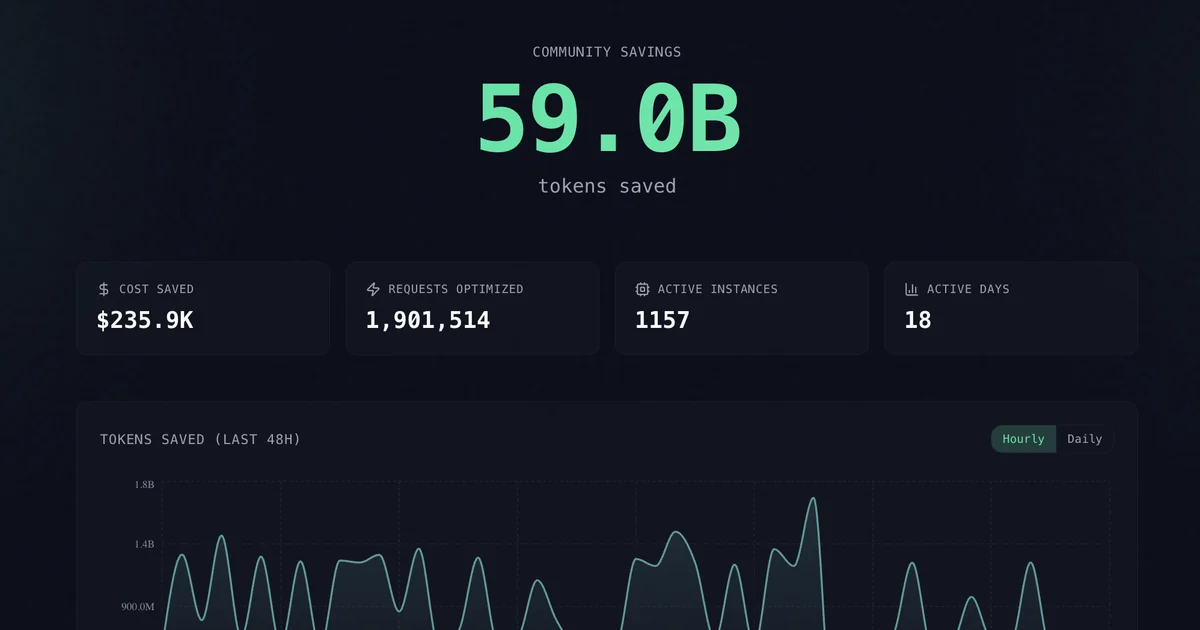
Apache-2.0 context-compression layer that wraps Claude Code, Codex, Cursor, OpenCode, and MCP clients so agents send fewer tool-output and history tokens.

Rust-based coding-agent harness with a native TUI, multi-session workflows, agent memory, swarm coordination, MCP, browser tooling, and broad model-provider support.
Alternative Tools to Consider

Source-available MCP plugin that keeps heavy tool output out of Claude Code, Codex, Cursor, and other coding-agent context windows.

Universal memory layer for AI agents that adds persistent context, retrieval, and personalization to coding workflows.

Open-source coding agent for the terminal with provider-agnostic model support, built-in agents, and optional desktop/IDE surfaces.

Open-source context database for AI agents that organizes memory, resources, and skills through a file-system-style hierarchy.
Do one more comparison before you commit to Lore
Strong picks usually survive one more internal check. Read deeper, compare a neighbor, then leave for the vendor page if the fit still holds.