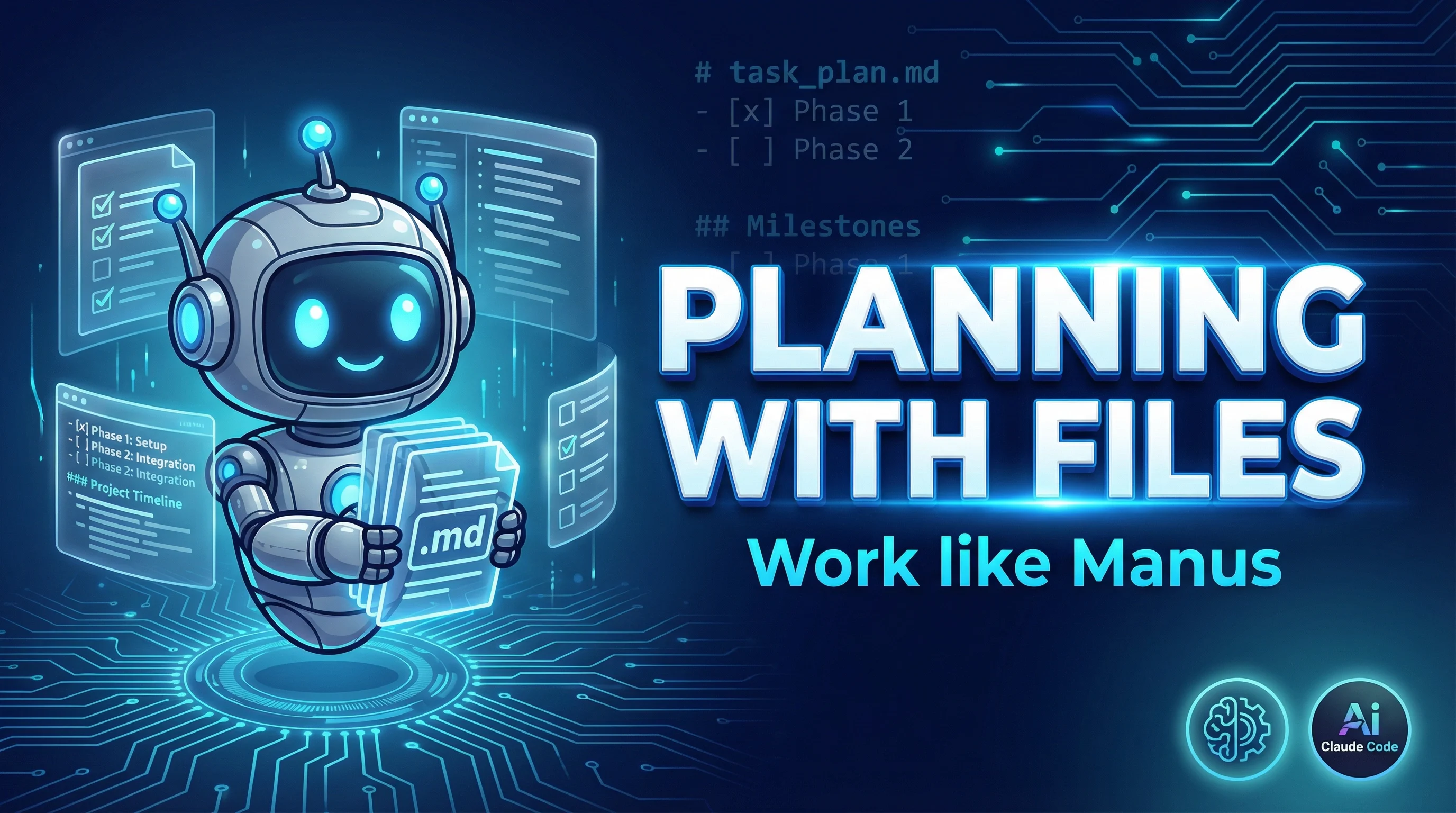
Planning with Files
Open-source persistent planning skill and plugin for coding agents that keeps task plans, findings, and progress on disk so work survives /clear, compaction, and crashes.
Do not bounce yet
Read the fit check, compare one alternative, then decide whether the vendor page is still your best next click.
Quick Verdict
Fast fit check before you leave the page
Make the fit call first. Vendor pages are good at selling, but they rarely tell you where the product is a bad match.
- Developers running long multi-step coding tasks where session resets and context compaction break continuity
- Teams mixing multiple coding agents and wanting a portable execution-state pattern across tools
- Power users who prefer inspectable markdown planning over hidden chat-history state
- This is workflow infrastructure, not a full coding agent, so it improves execution continuity rather than replacing the rest of your stack.
- Users still need discipline: writing plans badly or ignoring the files turns the system into theater instead of leverage.
- Hook-heavy setups can feel more operationally fiddly than a dead-simple single-agent chat workflow, especially for people who hate configuration.
Compare Next
Take one more internal step before the vendor pitch
This is where visitors usually jump out too early. Read one deeper take or open one alternative so the next click is informed instead of impulsive.
Alternative profile
Claude-Mem
Open-source persistent memory layer for Claude Code and other coding agents that captures session observations, compresses them, and injects relevant context back into future work.
Alternative profile
Context7
Documentation context layer that feeds up-to-date, version-specific library docs and code snippets into Cursor, Claude, and other coding agents.
Alternative profile
Repomix
Open-source CLI and MCP tool that packs whole repositories into AI-friendly formats so coding agents can reason over real codebases with less setup friction.
Planning with Files is for developers who are tired of watching coding agents lose the plot halfway through real work. Instead of trusting one fragile chat window to hold the plan, it writes active execution state to markdown files on disk, then re-injects that state through hooks and recovery flows when sessions get compacted, cleared, or restarted. That makes it relevant not because it generates code directly, but because it keeps longer agentic coding runs coherent.
Planning with Files earns a spot in a serious vibe-coding directory because it fixes a failure mode that wastes real engineering time: coding agents keep forgetting the plan once context gets compacted, the session resets, or the workflow gets handed off. Instead of pretending another chat pane solves that, it writes task state to markdown files on disk, re-injects the active plan through hooks, supports completion gating and autonomous modes for longer runs, and ships install paths across Claude Code, Codex, Cursor, GitHub Copilot, Gemini CLI, OpenCode, OpenClaw, and many more Agent Skills-compatible environments. That makes it much more defensible than a cosmetic wrapper, because the product is really about execution continuity and state management for agentic coding.
Why Choose Planning with Files?
Choose Planning with Files when the real problem is plan continuity and task-state persistence, not squeezing one more autocomplete gimmick out of a model.
Its filesystem-first design is strategically useful because the plan remains inspectable by humans and portable across multiple coding-agent clients.
Broad support across Claude Code, Codex, Cursor, Gemini CLI, OpenCode, OpenClaw, and related environments makes it more durable than a single-vendor plugin.
The product clears the credibility bar through repository traction, active releases, and a concrete install surface instead of relying on empty social-thread hype.
Key Features
Keeps task_plan.md, findings.md, and progress.md on disk so an agent can recover active execution state after /clear, compaction, crashes, or session handoff instead of starting half-blind.
Supports hook-driven plan reinjection, session recovery, and progress reminders across Claude Code, Codex, Cursor, GitHub Copilot, OpenCode, Gemini CLI, Kiro, OpenClaw, and many more Agent Skills-compatible runtimes.
Adds newer autonomous and gated modes for longer-running agent sessions, including a completion gate that can hold a run until the tracked plan is actually finished.
Works as both a skill/plugin-style integration and a terminal-friendly workflow, which matters because serious agentic coding usually spans editors, shells, and session resets rather than one happy-path demo.
Ships with extensive platform docs, hook adapters, templates, multilingual variants, and public release notes instead of hiding the real workflow behind vague marketing.
Stays open source under MIT, with concrete repository activity and public issue/PR history that let developers audit what the tool is actually doing.
Pros & Cons
- Planning with Files attacks a real reliability problem in agentic coding: execution-state loss, not just code generation quality.
- The filesystem-first approach is simple, inspectable, and portable across tools instead of locking planning state inside one vendor chat history.
- Cross-agent install coverage is unusually broad, which makes it useful for teams that mix Claude Code, Codex, Cursor, Gemini CLI, OpenCode, and OpenClaw.
- The public repo, release cadence, and install surface make it look like durable workflow infrastructure rather than another weekend wrapper.
- This is workflow infrastructure, not a full coding agent, so it improves execution continuity rather than replacing the rest of your stack.
- Users still need discipline: writing plans badly or ignoring the files turns the system into theater instead of leverage.
- Hook-heavy setups can feel more operationally fiddly than a dead-simple single-agent chat workflow, especially for people who hate configuration.
- The HN signal is relatively weak compared with GitHub traction, so adoption confidence comes more from repo reality than from a breakout public launch thread.
Detailed Use Cases for Planning with Files
Use Planning with Files when your coding agent keeps forgetting the plan after long sessions. Writing execution state to disk makes the workflow much less brittle than hoping context alone survives.
The tool is useful when you want phases, progress, and finish conditions tracked outside the model so long-running tasks are less likely to drift or terminate early.
Because the plan lives in plain markdown files, different tools and humans can inspect or continue the same work without depending on one proprietary session format.
If you work in Claude Code, Codex CLI, OpenCode, OpenClaw, or similar environments, Planning with Files gives you a durable planning layer without forcing a full IDE migration.
Who Should Use Planning with Files?
Developers running long multi-step coding tasks where session resets and context compaction break continuity
Teams mixing multiple coding agents and wanting a portable execution-state pattern across tools
Power users who prefer inspectable markdown planning over hidden chat-history state
Builders evaluating practical agent workflow infrastructure instead of another shallow code-generation wrapper
Perfect For
Keeping long multi-step coding tasks coherent when the agent would otherwise forget goals after context compaction, /clear, or session restarts.
Running planning-aware workflows across Claude Code, Codex, Cursor, OpenCode, Gemini CLI, or OpenClaw without rebuilding the persistence layer for each tool.
Managing longer agent runs where completion criteria, phase tracking, and explicit progress logging matter more than one-shot code generation speed.
Creating a portable execution-state pattern that humans and multiple agents can both inspect during handoffs or debugging.
Technical Details
Planning with Files Comparisons & Alternatives
Planning with Files review
Planning with Files vs Claude-Mem
persistent planning for Claude Code and Codex
markdown planning tool for coding agents
agentic coding workflow persistence
Planning with Files for Cursor and OpenClaw
Developers compare Planning with Files with other vibe coding tools when they need a better workflow fit, not just a better landing page.
Direct Competitors
Claude-Mem
agentmemory
Context7
Repomix
Similar Tools You Might Like
Open-source multi-harness plugin marketplace for shipping agents, skills, commands, and workflows across Claude Code, Codex CLI, Cursor, OpenCode, Gemini CLI, and Copilot.

Open-source coding agent for VS Code and the terminal with browser automation, MCP extensibility, and human-in-the-loop approvals.
Fully local Claude Code memory plugin that logs sessions and writes compact resume context without sending project data to an external model.
Alternative Tools to Consider

Open-source persistent memory layer for Claude Code and other coding agents that captures session observations, compresses them, and injects relevant context back into future work.

Documentation context layer that feeds up-to-date, version-specific library docs and code snippets into Cursor, Claude, and other coding agents.

Open-source CLI and MCP tool that packs whole repositories into AI-friendly formats so coding agents can reason over real codebases with less setup friction.
Persistent cross-session memory layer for coding agents, with MCP, hooks, and shared recall across Claude Code, Codex CLI, Gemini CLI, OpenClaw, and more.
Do one more comparison before you commit to Planning with Files
Strong picks usually survive one more internal check. Read deeper, compare a neighbor, then leave for the vendor page if the fit still holds.