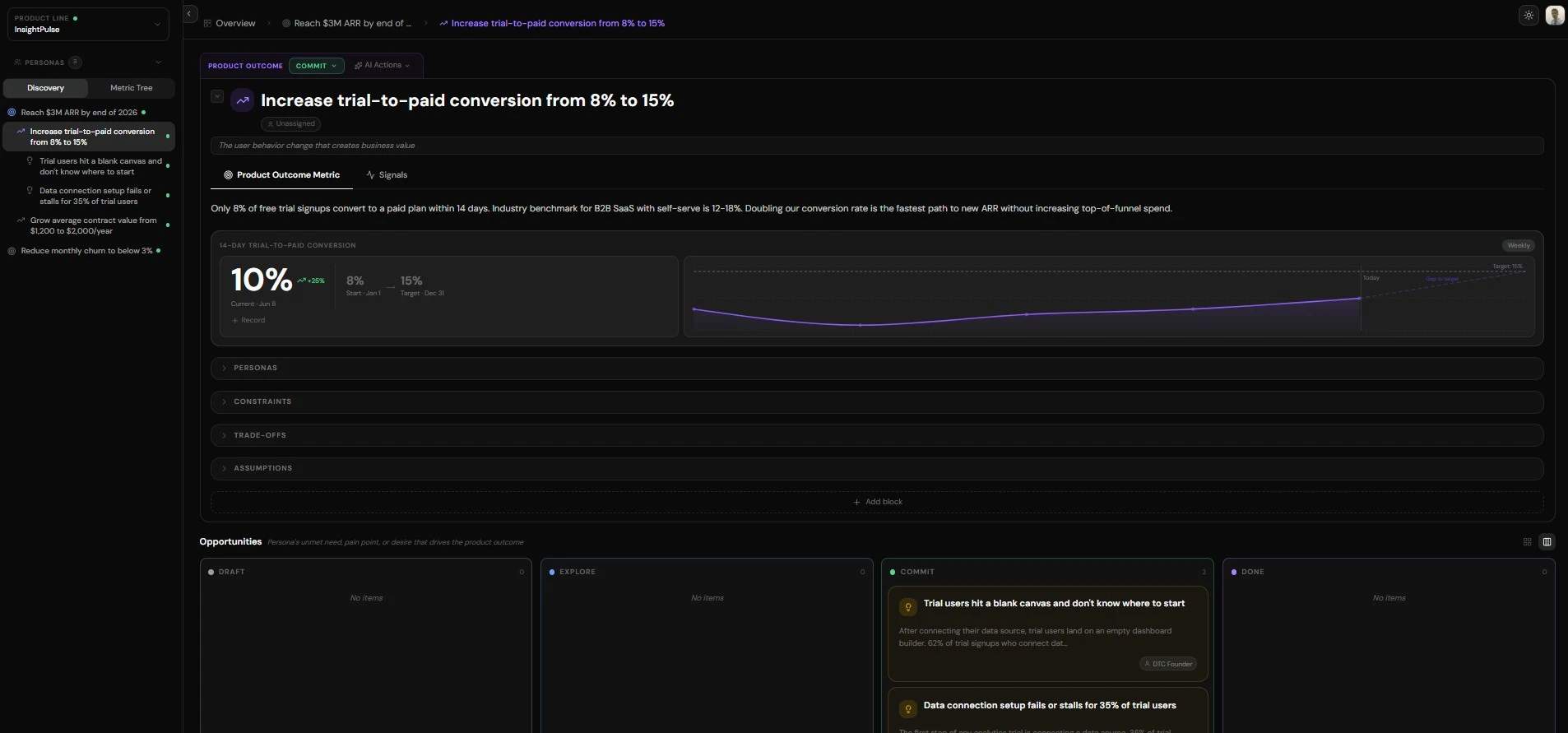
kster.ai
Structured product-context web app that gives Claude Code, Cursor, Copilot, and other coding agents a shared picture of goals, decisions, and stories over MCP.
Do not bounce yet
Read the fit check, compare one alternative, then decide whether the vendor page is still your best next click.
Quick Verdict
Fast fit check before you leave the page
Make the fit call first. Vendor pages are good at selling, but they rarely tell you where the product is a bad match.
- Founders and product-minded builders using Claude Code, Cursor, or Copilot who want agents to understand more than the repo
- Small teams where AI handles much of the implementation but humans still need a persistent decision layer
- Practitioners comparing product-context systems with task- or repo-context tools like Taskmaster, Lore, Repomix, and Context7
- Public traction is still thin: the surfaced HN launch was only a 3-point Show HN during review, and no stronger public GitHub or X adoption signals appeared.
- It is a proprietary hosted web app, so teams should verify export paths, governance, and lock-in risk before depending on it.
- The workflow only works if someone actually maintains the product context; if the tree rots, the agent context rots with it.
Compare Next
Take one more internal step before the vendor pitch
This is where visitors usually jump out too early. Read one deeper take or open one alternative so the next click is informed instead of impulsive.
Alternative profile
Context7
Documentation context layer that feeds up-to-date, version-specific library docs and code snippets into Cursor, Claude, and other coding agents.
Alternative profile
Lore
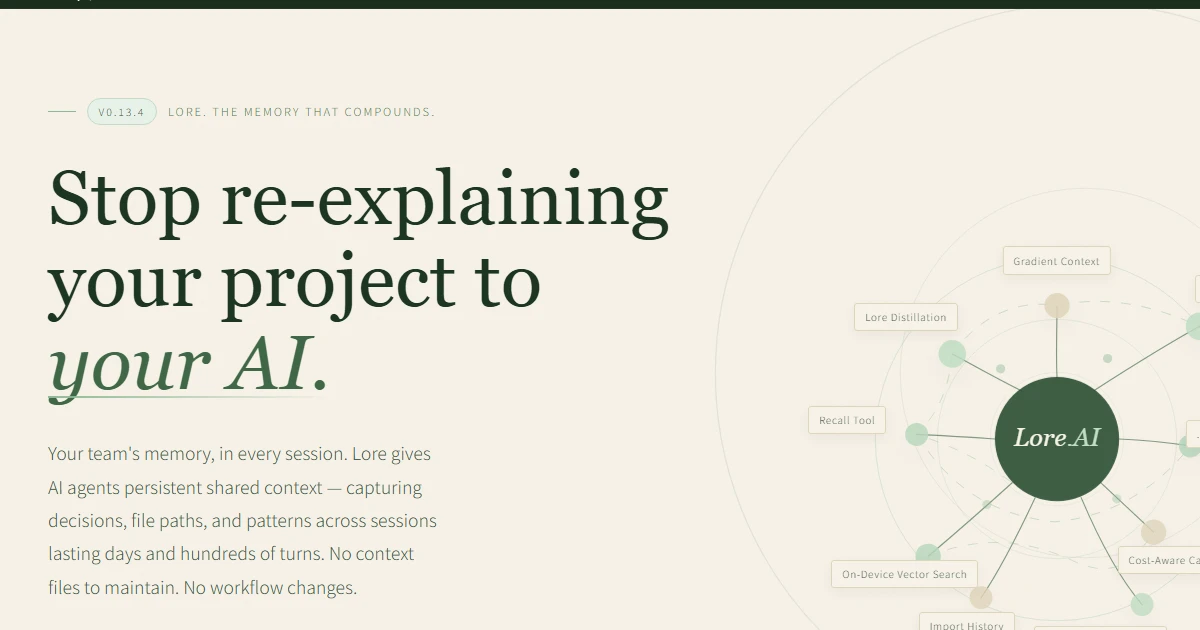
Local memory and context-management gateway that gives Claude Code, Codex, OpenCode, Pi, and similar coding agents durable shared recall.
Alternative profile
Repomix
Open-source CLI and MCP tool that packs whole repositories into AI-friendly formats so coding agents can reason over real codebases with less setup friction.
kster.ai is interesting for one reason: it aims at a real bottleneck in vibe coding instead of pretending code generation is the whole game. Agents can write code fast, but they still do not know your product goals, decision history, or trade-offs unless you keep re-explaining them. kster.ai tries to move that context into a structured shared system that coding agents can read over MCP.
kster.ai is not another code generator. It is a product-context layer for agentic development: teams build a structured picture of the product, then let tools like Claude Code, Cursor, and GitHub Copilot read that context over MCP before implementation starts. That matters because vibe coding breaks down when the agent can write code fast but does not know the product goals, trade-offs, or past decisions unless you keep re-explaining them. kster.ai tries to turn that missing context into a maintained system instead of a pile of drifting markdown notes.
Why Choose kster.ai?
Choose kster.ai when your problem is not raw code output but the fact that your coding agent keeps missing the product why.
Its pitch is more defensible than generic AI PM fluff because it is tied directly to coding-agent workflows through MCP and named integrations like Claude Code, Cursor, and Copilot.
The shared-context model is useful for founder-led teams that keep rebuilding the same background prompt every session.
Do not over-romanticize it though: public traction is still early, so the right posture is evaluate carefully, not assume category leadership.
Key Features
Builds a structured product picture around goals, problems, decisions, tests, and stories instead of dumping context into loose notes.
Lets Claude Code, Cursor, GitHub Copilot, and other coding agents read that product context over MCP before they start implementing.
Uses AI as an editor to help shape context layer by layer rather than forcing founders to author every artifact from scratch.
Generates downstream artifacts such as PRDs, prototypes, user stories, FAQs, help docs, and release notes from the same shared context base.
Keeps product understanding in a browser-native shared system rather than hiding it inside one engineer's local prompt files.
Official site says you can start free with one product line and no card, which lowers the cost of trying it on a real project.
Pros & Cons
- It targets a real failure mode in agentic coding: the model can write code quickly but still lacks product judgment and prior decisions.
- The product is focused on shared context, which is more credible than pretending to replace the editor or autonomously build the whole company.
- Support for tools people already use like Claude Code, Cursor, and Copilot makes the workflow easier to slot into an existing stack.
- The UX and messaging are specific enough to feel like a product with a thesis, not another disposable MCP wrapper with a landing page.
- Public traction is still thin: the surfaced HN launch was only a 3-point Show HN during review, and no stronger public GitHub or X adoption signals appeared.
- It is a proprietary hosted web app, so teams should verify export paths, governance, and lock-in risk before depending on it.
- The workflow only works if someone actually maintains the product context; if the tree rots, the agent context rots with it.
- Public technical details about the MCP and API depth are still lighter than the marketing thesis, so serious teams should validate the integration quality hands-on.
Detailed Use Cases for kster.ai
Use kster.ai when the missing piece is not repo access but the goals, decisions, and trade-offs that sit outside the codebase.
The same shared context can drive PRDs, stories, FAQs, and release notes instead of forcing teams to rewrite product background in separate tools.
If every new Claude Code or Cursor session begins with re-explaining the business, kster.ai is the kind of layer worth testing.
The value proposition is not autonomous product management; it is moving humans up a level so they spend less time restating context and more time making decisions.
Who Should Use kster.ai?
Founders and product-minded builders using Claude Code, Cursor, or Copilot who want agents to understand more than the repo
Small teams where AI handles much of the implementation but humans still need a persistent decision layer
Practitioners comparing product-context systems with task- or repo-context tools like Taskmaster, Lore, Repomix, and Context7
Teams tired of maintaining ad hoc markdown memory files that drift away from the real product state
Perfect For
Give Claude Code, Cursor, or Copilot the product goals and decision history before asking for implementation work.
Turn accumulated product context into PRDs, stories, and related artifacts without rewriting the same background every time.
Reduce repeated prompting and re-explaining in founder-led vibe coding workflows.
Keep a shared product picture for teams where AI does most of the implementation labor but humans still own judgment.
Technical Details
kster.ai Comparisons & Alternatives
kster.ai review
kster.ai vs Taskmaster
structured product context for Claude Code
MCP product context tool for Cursor
product context for coding agents
Developers compare kster.ai with other vibe coding tools when they need a better workflow fit, not just a better landing page.
Direct Competitors
Taskmaster
Context7
Lore
Repomix
Similar Tools You Might Like

Cloud-executed AI software engineer that takes repository tasks from prompt to tested diff and pull request.

Agent-native software development workspace for delegating refactors, migrations, incident response, and other repo tasks across IDE, CLI, browser, and chat.

Google's asynchronous coding agent for GitHub repos, cloud-executed tasks, test runs, diff review, and PR creation.
Alternative Tools to Consider

Documentation context layer that feeds up-to-date, version-specific library docs and code snippets into Cursor, Claude, and other coding agents.
Local memory and context-management gateway that gives Claude Code, Codex, OpenCode, Pi, and similar coding agents durable shared recall.

Open-source CLI and MCP tool that packs whole repositories into AI-friendly formats so coding agents can reason over real codebases with less setup friction.
AI-driven task management layer for Claude Code, Cursor, Codex, Windsurf, Roo, and other coding agents.
Do one more comparison before you commit to kster.ai
Strong picks usually survive one more internal check. Read deeper, compare a neighbor, then leave for the vendor page if the fit still holds.