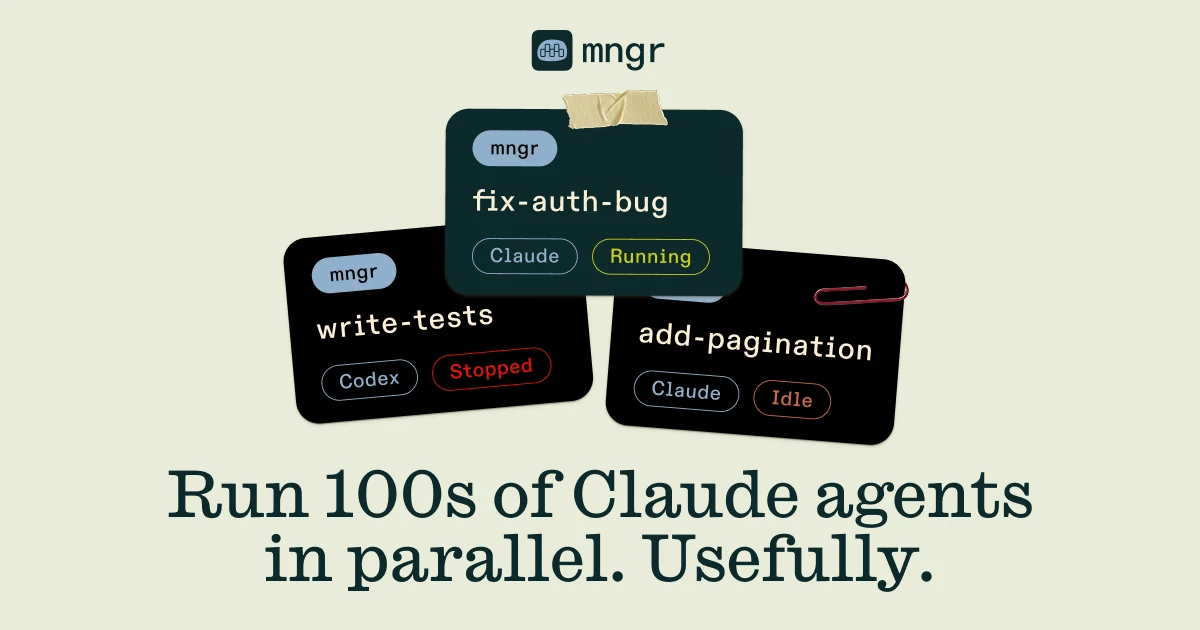
mngr
Unix-style CLI for managing coding agents across local machines, containers, remote hosts, and structured execution environments.
Do not bounce yet
Read the fit check, compare one alternative, then decide whether the vendor page is still your best next click.
Quick Verdict
Fast fit check before you leave the page
Make the fit call first. Vendor pages are good at selling, but they rarely tell you where the product is a bad match.
- Infra-minded developers managing coding agents beyond a single local machine
- Teams experimenting with local, containerized, or remote execution for agentic coding workflows
- Operators who prefer CLI-first control over where agents run and how they are managed
- The public adoption signal is still early, so it should be treated as an emerging tool rather than a category standard.
- The project is operator- and CLI-oriented, which is great for serious builders and bad for users wanting a polished beginner GUI.
- Remote execution and multi-environment control can add real complexity fast if your workflow does not actually need it.
Compare Next
Take one more internal step before the vendor pitch
This is where visitors usually jump out too early. Read one deeper take or open one alternative so the next click is informed instead of impulsive.
Alternative profile
Agent Deck
Open-source terminal session manager for running and supervising multiple AI coding agents across isolated git worktrees.
Alternative profile
Agent of Empires
Open-source terminal and web session manager for running multiple AI coding agents across isolated git worktrees and sandboxes.
Alternative profile
Pi
Minimal open-source terminal coding agent focused on extensibility, tree-structured sessions, and shell-native repo workflows.
mngr is for builders who have already realized that one laptop-bound coding agent is not a durable operating model. Instead of treating agents like glorified local chat sessions, it frames them as managed workloads that can run across local machines, containers, and remote environments under one CLI-oriented control surface.
mngr is a control-plane style CLI for developers who already know that serious coding-agent work rarely stays inside one local shell. Instead of treating agents as single-machine toys, it gives you a Unix-style way to provision, run, and manage coding agents across local hosts, Docker, Modal, and remote environments. That makes it directly relevant to vibe coding teams who care about operator workflow, execution placement, and infrastructure control more than another IDE-side chat panel.
Why Choose mngr?
Choose mngr when the next problem in your agent workflow is execution management and placement, not getting one more sidebar assistant into your editor.
Its infrastructure-oriented model is more interesting than thin wrappers because it treats coding agents as workloads you route and supervise deliberately.
The terminal-native workflow matches teams that already operate through shells, containers, and remote environments rather than browser-only tooling.
If you want more control without immediately collapsing into one hosted IDE vendor, mngr is worth tracking.
Key Features
Provides a Unix-style CLI for creating, managing, and routing coding-agent execution across local and remote environments.
Supports running agents on local hosts, Docker, Modal, and other structured execution targets instead of assuming everything lives on one developer machine.
Positions coding-agent management as infrastructure, which is more relevant for teams scaling workflows than another editor-side assistant veneer.
Comes with an official Imbue product page and public GitHub repository, making the product surface more concrete than many launch-week wrappers.
Fits operators who want explicit control over where agent jobs run and how they are managed.
Keeps the core experience terminal-native, which matches how many serious coding-agent operators already work.
Pros & Cons
- mngr is aimed at a real operational problem: moving beyond single-machine agent workflows into something more controllable and repeatable.
- The execution-target framing is strategically useful because the next bottleneck in agentic coding is often placement, isolation, and management, not raw prompting.
- An official product page plus active public repo gives it more credibility than projects that exist only as a README concept.
- It fits teams that want infrastructure-minded control without immediately buying into one closed hosted IDE stack.
- The public adoption signal is still early, so it should be treated as an emerging tool rather than a category standard.
- The project is operator- and CLI-oriented, which is great for serious builders and bad for users wanting a polished beginner GUI.
- Remote execution and multi-environment control can add real complexity fast if your workflow does not actually need it.
- License details are less cleanly obvious than classic MIT/Apache projects, so teams with strict procurement rules should verify upstream terms directly.
Detailed Use Cases for mngr
Use mngr when your workflows need coding agents to run across local hosts, containers, or remote environments instead of being trapped inside one laptop shell.
It is a better fit than simple local wrappers when you care about execution placement, repeatability, and operational control.
mngr makes more sense for teams already comfortable with shells, containers, and remote infrastructure than for users seeking a beginner-friendly GUI assistant.
Because it focuses on management and execution rather than just chat, mngr is worth watching if you think the next layer of agent tooling is operational infrastructure.
Who Should Use mngr?
Infra-minded developers managing coding agents beyond a single local machine
Teams experimenting with local, containerized, or remote execution for agentic coding workflows
Operators who prefer CLI-first control over where agents run and how they are managed
Builders evaluating emerging infrastructure layers around coding-agent execution
Perfect For
Managing coding agents across local machines, containers, and remote environments from one CLI-oriented workflow.
Giving infra-minded teams more control over where agent work runs instead of keeping everything tied to one workstation.
Experimenting with coding-agent execution models that treat agents as managed workloads rather than glorified local assistants.
Building repeatable operational workflows around agent placement, execution, and supervision.
Technical Details
mngr Comparisons & Alternatives
mngr review
mngr vs Agent Deck
mngr vs Agent of Empires
CLI for managing coding agents
remote coding agent orchestration tool
Developers compare mngr with other vibe coding tools when they need a better workflow fit, not just a better landing page.
Direct Competitors
Agent Deck
Agent of Empires
Gas City
OpenClaw ACP flows
Similar Tools You Might Like

Terminal-native coding agent from Charm with multi-model support, LSP context, MCP connectivity, and strong Windows/macOS/Linux support.
AI-driven task management layer for Claude Code, Cursor, Codex, Windsurf, Roo, and other coding agents.
Open-source CLI that gives AI coding agents visual verification through browser recordings, screenshots, logs, and PR-ready proof artifacts.
Alternative Tools to Consider

Open-source terminal session manager for running and supervising multiple AI coding agents across isolated git worktrees.

Open-source terminal and web session manager for running multiple AI coding agents across isolated git worktrees and sandboxes.

Minimal open-source terminal coding agent focused on extensibility, tree-structured sessions, and shell-native repo workflows.

Minimal terminal coding harness with extensions, skills, tree-structured sessions, and serious multi-provider model support.
Do one more comparison before you commit to mngr
Strong picks usually survive one more internal check. Read deeper, compare a neighbor, then leave for the vendor page if the fit still holds.