Claude Context
MIT-licensed semantic code search MCP and VS Code extension that gives Claude Code, Codex, Gemini CLI, and other coding agents repo-scale context.
Do not bounce yet
Read the fit check, compare one alternative, then decide whether the vendor page is still your best next click.
Quick Verdict
Fast fit check before you leave the page
Make the fit call first. Vendor pages are good at selling, but they rarely tell you where the product is a bad match.
- Developers using Claude Code, Codex CLI, Gemini CLI, Qwen Code, or other MCP clients on large repositories
- Teams that want semantic code search for both humans in VS Code and agents over MCP
- AI engineering teams evaluating retrieval infrastructure for coding-agent workflows
- The default cloud-oriented setup can involve external embedding providers and vector databases, so source-code privacy needs explicit review.
- It is a retrieval layer, not a full coding agent, and still depends on the downstream agent to use retrieved context correctly.
- Large monorepos still require indexing discipline, ignore patterns, and cost monitoring for embeddings and vector storage.
Compare Next
Take one more internal step before the vendor pitch
This is where visitors usually jump out too early. Read one deeper take or open one alternative so the next click is informed instead of impulsive.
Alternative profile
Context7
Documentation context layer that feeds up-to-date, version-specific library docs and code snippets into Cursor, Claude, and other coding agents.
Alternative profile
Cursor
The AI-first code editor built for pair-programming with AI
Alternative profile
Repomix
Open-source CLI and MCP tool that packs whole repositories into AI-friendly formats so coding agents can reason over real codebases with less setup friction.
Claude Context is worth tracking because context retrieval has become one of the hard limits in vibe coding. A coding agent can be strong at edits and still waste time if it cannot find the right service, model, migration, or business rule in a large repository. Claude Context indexes the codebase and exposes semantic search through MCP so agents can pull relevant code into context instead of blindly reading or pasting whole folders.
Claude Context is a code-retrieval layer for agentic coding workflows where grep and manual file stuffing stop scaling. The project indexes a repository with hybrid semantic search, AST-aware chunking, incremental Merkle-tree updates, and Milvus or Zilliz Cloud vector storage, then exposes the relevant code through an MCP server and a VS Code extension. That makes it useful for Claude Code, Codex CLI, Gemini CLI, Qwen Code, and other MCP-capable coding agents that need to find the right implementation details across large codebases without loading everything into the prompt.
Why Choose Claude Context?
Choose Claude Context when Claude Code, Codex CLI, Gemini CLI, Qwen Code, or another MCP-capable agent needs repo-scale search instead of manual file selection.
The strongest fit is large or unfamiliar codebases where keyword grep misses behavior-level questions such as authentication flow, data validation, or cross-file state changes.
Hybrid search, AST-aware chunking, incremental indexing, and VS Code support make it more operational than a one-off prompt stuffing script.
Be careful with privacy and cost. The setup can use external embedding providers and cloud vector storage, so sensitive repositories need a deliberate deployment choice.
Key Features
MCP server that lets Claude Code, Codex CLI, Gemini CLI, Qwen Code, and other compatible agents retrieve relevant code from an indexed repository.
Hybrid search combines BM25-style lexical matching with dense vector retrieval so agents can ask natural-language questions about code paths and behavior.
AST-aware code chunking with automatic fallback helps preserve function and class boundaries better than naive fixed-size text splitting.
Incremental indexing uses Merkle-tree style file synchronization so changed files can be refreshed without rebuilding the whole codebase index.
VS Code Semantic Code Search extension provides a human-facing search surface alongside the agent-facing MCP package.
Supports OpenAI, VoyageAI, Ollama, and Gemini embeddings with Milvus or Zilliz Cloud vector storage.
Pros & Cons
- It solves a real agentic coding failure mode: agents can write code, but they often waste turns rediscovering where the relevant implementation lives.
- The MCP surface makes the tool useful across multiple coding agents instead of being locked to one IDE or one model provider.
- MIT licensing, npm packages, and a visible VS Code extension path make it easier to evaluate than closed context-indexing products.
- The repository has strong public traction for this niche, with 12k+ GitHub stars and recent package activity during the audit.
- The default cloud-oriented setup can involve external embedding providers and vector databases, so source-code privacy needs explicit review.
- It is a retrieval layer, not a full coding agent, and still depends on the downstream agent to use retrieved context correctly.
- Large monorepos still require indexing discipline, ignore patterns, and cost monitoring for embeddings and vector storage.
- The strongest social proof is GitHub traction and technical discussion; published production adoption numbers are not available.
Detailed Use Cases for Claude Context
Use Claude Context before asking an agent to edit a large repository so it can retrieve relevant functions, config, and call paths instead of guessing which files matter.
The MCP server lets compatible agents fetch targeted code snippets instead of loading broad directories into every turn.
The VS Code extension gives developers a manual semantic-search surface while the MCP package gives agents access to the same indexed context.
Teams can choose embedding providers such as OpenAI, VoyageAI, Ollama, or Gemini and store vectors in Milvus or Zilliz Cloud depending on cost, latency, and privacy requirements.
Who Should Use Claude Context?
Developers using Claude Code, Codex CLI, Gemini CLI, Qwen Code, or other MCP clients on large repositories
Teams that want semantic code search for both humans in VS Code and agents over MCP
AI engineering teams evaluating retrieval infrastructure for coding-agent workflows
Privacy-conscious teams comparing local Milvus and local embeddings against managed vector search
Perfect For
Giving Claude Code or Codex CLI semantic search over a large repository before asking it to implement or refactor a feature.
Finding functions, data flows, and cross-file behavior when keyword grep misses the right code path.
Adding a reusable context-retrieval MCP server to team agent setups instead of pasting huge directory dumps into every prompt.
Using VS Code semantic search as a human review companion while an agent works through the same indexed codebase.
Technical Details
Claude Context Comparisons & Alternatives
Claude Context review
Claude Context vs Context7
Claude Context vs Repomix
semantic code search MCP
Claude Code semantic search
Codex CLI MCP code search
Zilliz Claude Context
agentic coding code retrieval
Developers compare Claude Context with other vibe coding tools when they need a better workflow fit, not just a better landing page.
Direct Competitors
Context7
Understand Anything
Repomix
Sourcegraph Cody
Cursor codebase search
grep or ripgrep
Similar Tools You Might Like
Open-source multi-harness plugin marketplace for shipping agents, skills, commands, and workflows across Claude Code, Codex CLI, Cursor, OpenCode, Gemini CLI, and Copilot.

Open-source coding agent for VS Code and the terminal with browser automation, MCP extensibility, and human-in-the-loop approvals.

Open-source semantic retrieval and editing layer that upgrades Claude Code, Codex, Cursor, and other coding agents with IDE-like code intelligence.
Alternative Tools to Consider

Documentation context layer that feeds up-to-date, version-specific library docs and code snippets into Cursor, Claude, and other coding agents.


Open-source CLI and MCP tool that packs whole repositories into AI-friendly formats so coding agents can reason over real codebases with less setup friction.
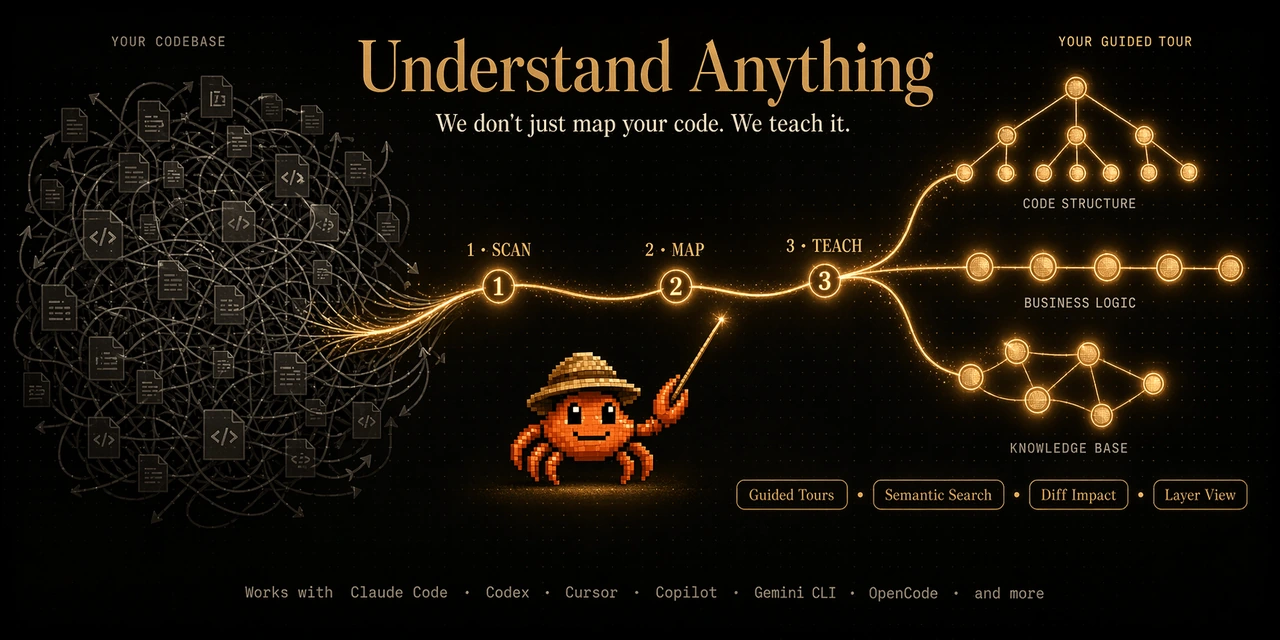
Open-source codebase knowledge graph plugin and dashboard that helps coding agents and humans understand repository structure, business logic, and onboarding flows.
Do one more comparison before you commit to Claude Context
Strong picks usually survive one more internal check. Read deeper, compare a neighbor, then leave for the vendor page if the fit still holds.